Maternity leave in Switzerland: what you get paid
14 weeks at 80% of your pay, up to CHF 220 a day. Work out your amount.
- Your pay
- CHF 6’500
- Allowance
- CHF 5’200
Canton of Geneva: mothers who work there get 16 weeks and up to CHF 329.60 per day. This calculator shows the federal amount only. The Geneva rule (OCAS, in French)
Indicative figures, as of 2026. Your compensation office's calculation is binding (leaflet 6.02, ahv-iv.ch).
The 16 weeks after the birth
The other parent has 2 weeks of paid leave, to be taken within 6 months of the birth.
Eligibility requirements
- You must have been insured under the old-age and survivors' insurance (AHV) for 9 months before the birth
- You must have been in gainful employment for at least 5 months during that period
- Self-employed women are also eligible
- If you are unemployed at the time of the birth and receiving daily allowances, you are entitled too
How to apply
- Employees: You fill in the registration form and submit it through your employer. Your employer confirms your employment and salary and forwards it to their compensation fund (Ausgleichskasse)
- Self-employed, unemployed mothers or mothers unable to work: apply directly to the compensation fund
- Required: birth certificate and proof of employment
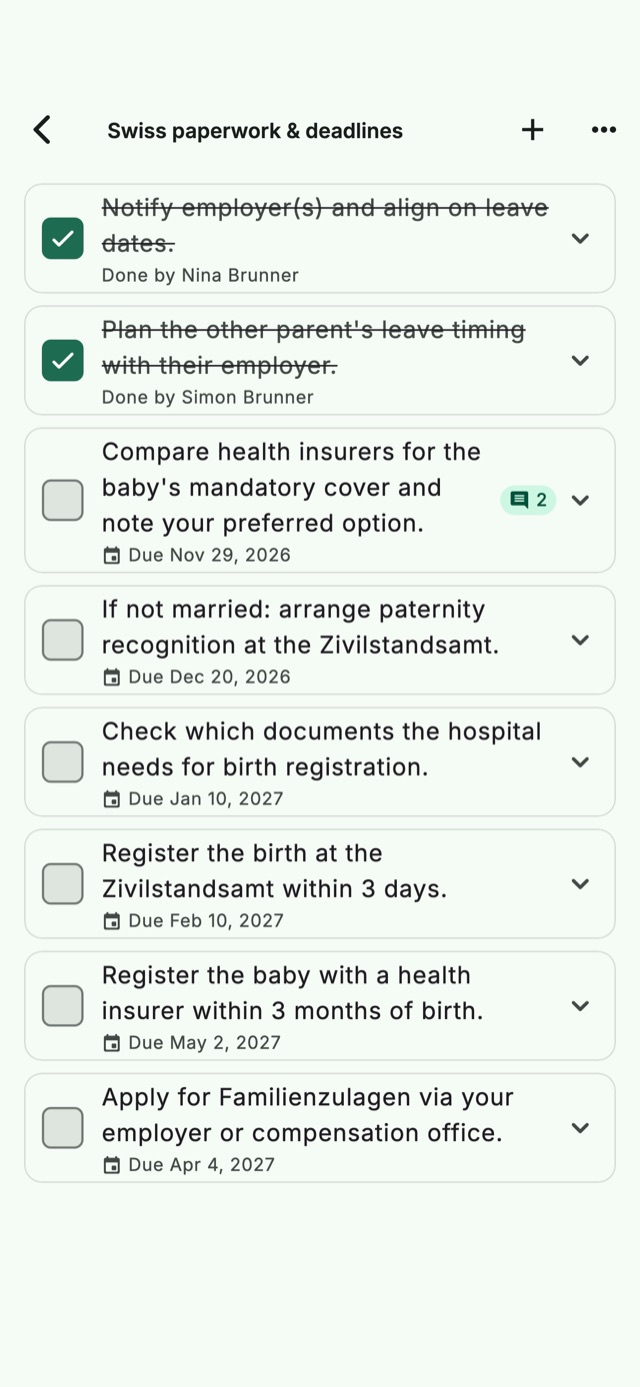
Checklists with Swiss deadlines
Birth registration, health insurance, family allowances: every task with a date, matched to your canton. Both parents see what is done.

Scan with your phone to install Momoli
momoli.ch/app
The details
Duration and compensation
Mothers are entitled to 14 weeks (98 days) of paid maternity leave after the birth. Maternity compensation (Mutterschaftsentschädigung, MSE) amounts to 80% of salary, up to a maximum of CHF 220 per day.
Eligibility requirements
- You must have been insured under the old-age and survivors' insurance (AHV) for 9 months before the birth
- You must have been in gainful employment for at least 5 months during that period
- Self-employed women are also eligible
- If you are unemployed at the time of the birth and receiving daily allowances, you are entitled too
Periods in which you were insured or employed in the United Kingdom, the EU or EFTA count towards the nine months of insurance and five months of employment (leaflet 6.02). Periods from other states do not count. Newly arrived and pregnant covers what else works differently for newcomers.
Protection during leave
- You cannot be dismissed during pregnancy and for 16 weeks after the birth
- The entitlement starts on the day of the birth and ends after 98 days
- If you return to work early, the compensation ends
Special cases
Hospital stay of the newborn
If your baby must stay in hospital continuously for at least 2 weeks directly after the birth (for example due to premature birth or illness), your maternity leave is extended by the duration of the hospital stay. A maximum of 56 additional days (8 weeks) is possible. Maternity leave can then last up to 22 weeks. The condition is that at the time of the birth you already intended to return to work after maternity leave, and that you prove this to the compensation fund together with a medical certificate for the hospital stay. If you receive unemployment benefit or are unable to work after your maternity leave, special rules apply; ask the compensation fund. This rule has been in effect since July 2021 (Art. 16c para. 3 EOG).
From 1 July 2027 the extension will also apply if you yourself have to stay in hospital for at least 2 consecutive weeks within 2 weeks of the birth. The cap of 56 days will then be removed: the leave is extended by the actual length of the hospital stay (Art. 16c para. 3 EOG, amendment of 19 December 2025).
Adoption leave
Since January 2023, adoptive parents are entitled to 2 weeks of paid leave. It can be taken within the first year after the placement of a child under 4 years old. The compensation is also 80% of salary (max. CHF 220/day). The 2 weeks can be split between the adoptive parents.
Good to know
- Holiday entitlement is not reduced by maternity leave
- Some employers or cantonal laws provide additional leave or salary top-ups
- The leave cannot be split or interrupted
- A smaller working percentage (Pensum) after the leave also changes the insured salary in your pension fund (Pensionskasse), as explained in Reducing your working percentage: what happens to your pension
Other parent's leave (Vaterschaftsurlaub, 2 weeks)
Overview
Since 1 January 2021, the other parent has been entitled to 2 weeks (10 working days) of paid leave after the birth of a child. In everyday language this is paternity leave (Vaterschaftsurlaub). The law speaks of the other parent's leave because, besides the father, the mother's wife is also entitled if she legally counts as the other parent.
Key details
- Duration: 10 working days (2 weeks) full time
- Part-time: If you work part time, you also get two weeks of leave and 14 daily allowances at 80% of your part-time income; the number of days of leave can depend on your level of employment
- Compensation: 80% of salary, max. CHF 220 per day
- Deadline: Must be taken within 6 months of the birth
- Flexibility: Can be taken as individual days or in one block
- Funding: through the loss-of-earnings scheme (Erwerbsersatzordnung, EO), like maternity compensation
Eligibility requirements
- Legal parent of the child at the time of birth or within 6 months afterwards (e.g. through acknowledgement of paternity after the birth)
- Insured under the old-age and survivors' insurance (AHV) for the 9 months before the birth
- In paid work (employed or self-employed) for at least 5 months during that period
- Also available to self-employed people
How to apply
- Inform your employer as early as possible
- Employees: You fill in the registration form and submit it through your employer. Your employer confirms your employment and salary and forwards it to their compensation fund (Ausgleichskasse)
- Self-employed, unemployed or unable to work: apply directly to the compensation fund
- Required: birth certificate (or acknowledgement of paternity)
Sources (11)
- BSV (Bundesamt für Sozialversicherungen) (accessed 03.09.2026)
- AHV/IV (Merkblatt 6.02) (accessed 14.03.2026)
- SECO (Arbeitnehmerschutz) (accessed 27.08.2026)
- Fedlex – EOG Art. 16c (accessed 21.03.2026)
- Fedlex – EOG-Änderung vom 19. Dezember 2025 (BBl 2026 29) (accessed 27.08.2026)
- OCAS Genève – Allocation de maternité (accessed 13.11.2026)
- Kanton Genf – LAMat (rsGE J 5 07, Stand 1. Januar 2024) (accessed 13.11.2026)
- OCAS Genève – Allocation à l'autre parent (accessed 13.11.2026)
- BSV (Bundesamt für Sozialversicherungen) (accessed 03.09.2026)
- AHV/IV (Merkblatt 6.04) (accessed 21.03.2026)
- BSV – FAQ AHV-Nummer für ein neugeborenes Kind (accessed 27.08.2026)
Last reviewed: 25.09.2026 The authorities and funds responsible have the final say. This page is no substitute for medical or legal advice.